
NEWS
International Women’s Day – 8 March
International Women’s Day – 8 March
Women in Prison: Advancing Gender-Responsive Justice and Preventing Violence in Detention
Madrid, Spain, 8 March 2026
On the occasion of International Women’s Day, 8 March, the Centre for Development and Justice International (CDJI) calls for renewed global commitment to protecting the rights and dignity of women and girls deprived of liberty and for stronger implementation of international standards, particularly the United Nations Bangkok Rules.
As Baroness Vivien Stern, Member of the UK House of Lords and Honorary President of CDJI, has long emphasised in her work on penal reform, women in prison remain among the most overlooked groups within criminal justice systems worldwide. Her longstanding advocacy has highlighted that prison systems historically designed for men often fail to recognise the distinct realities and vulnerabilities faced by women in detention.
According to the World Female Imprisonment List (Institute for Crime & Justice Policy Research, 2024), more than 733,000 women and girls are currently imprisoned worldwide, representing approximately 6.8% of the global prison population. While women constitute a minority of those deprived of liberty, the female prison population has increased by approximately 57% since 2000, growing at a significantly faster rate than the male prison population.
Many women who come into contact with the criminal justice system have experienced poverty, discrimination, domestic violence, or other forms of trauma prior to detention. In addition, women prisoners are often primary caregivers, meaning that imprisonment can have far-reaching consequences for children, families, and communities.
Justice Renate Winter, Honorary President of the CDJI Board, noted that:

“Is there any country worldwide that can prosper without the social and economic contribution of women? Why then not granting them the same possibilites and chances as men?
Because men are better? Not true!
Stronger? Not true!
More intelligent? Not true!
More powerful? True!
And they don`t want to share? True!”
Sexual and Gender-Based Violence in Detention
One of the most serious and often underreported challenges faced by women deprived of liberty is the risk of sexual and gender-based violence in detention.
International human rights monitoring bodies have documented that women in detention may face heightened risks of sexual harassment, abuse, coercion, and exploitation, particularly in environments where safeguards and reporting mechanisms are insufficient.
Elīna Šteinerte, Vice-Chair of the UN Subcommittee on Prevention of Torture (SPT) and Chair of the CDJI Board, emphasised the importance of strong safeguards in detention settings:
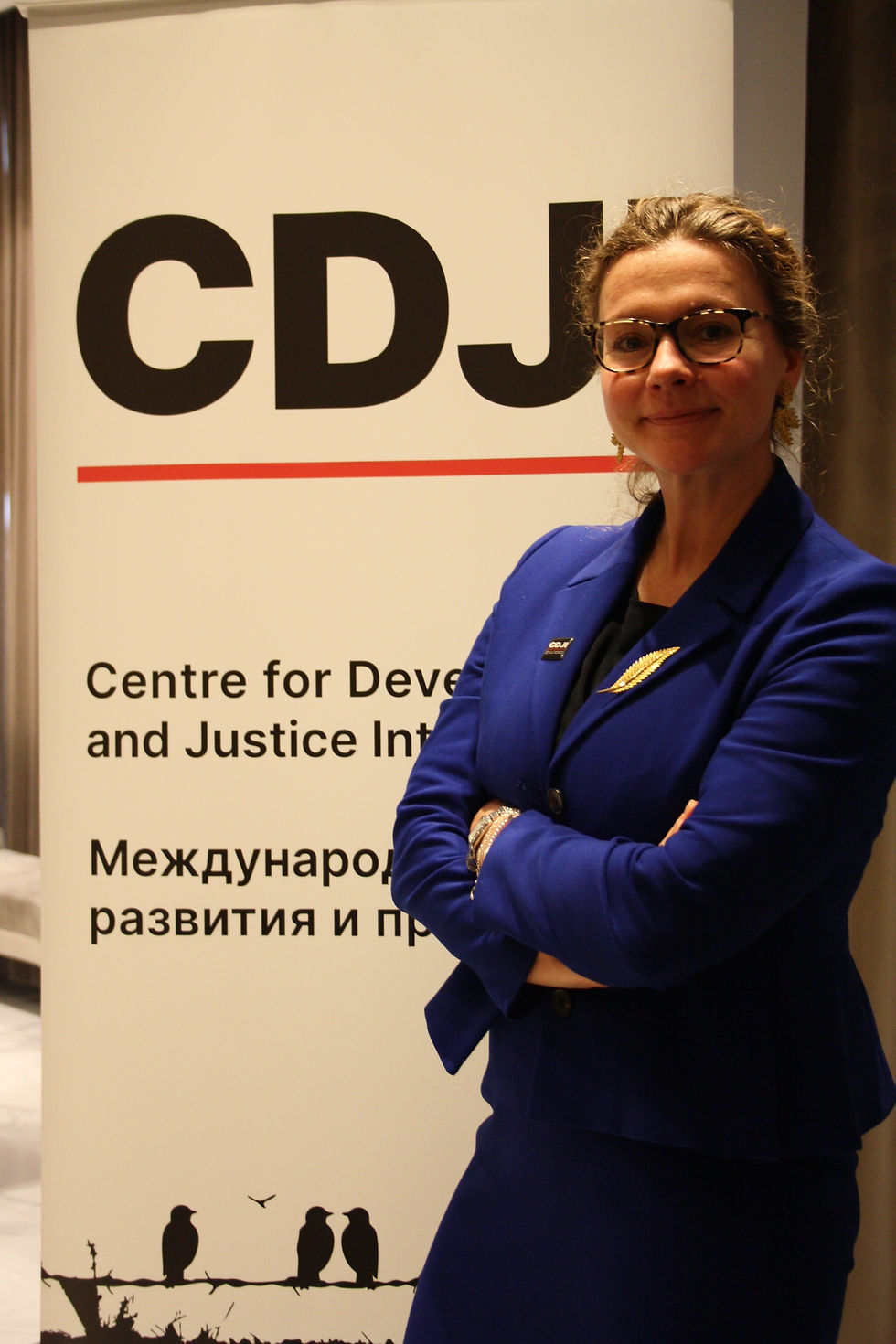
"As we mark the International Women’s Day, we once again recall that women’s rights are human rights and human rights are women’s rights. Gender justice is both about law and practice, underpinned by equality of rights and freedoms. And so, the promotion and protection of gender justice entails not only the reform of discriminatory laws and policies, but also efforts to counter harmful social norms and practices, institutionalised discrimination, lack of access to resources, services and opportunities, and gender roles and stereotypes arising from patriarchal power relations, thereby addressing the underlying structural barriers that perpetuate gender discrimination and inequality."
Preventing sexual and gender-based violence requires clear institutional safeguards, trained personnel, confidential reporting mechanisms, and effective accountability structures. Protection from violence is not only a matter of prison management - it is a fundamental human rights obligation.
International standards such as the UN Bangkok Rules (2010) and the UN Nelson Mandela Rules (2015) explicitly require states to ensure that women deprived of liberty are protected from all forms of violence, abuse, and ill-treatment.
Independent Monitoring and Oversight
Independent monitoring mechanisms play a crucial role in preventing abuse and ensuring accountability in places of detention.
Bodies such as National Preventive Mechanisms (NPMs) established under the Optional Protocol to the UN Convention against Torture (OPCAT) are mandated to regularly visit places of detention and assess the treatment of detainees and the conditions in which they are held.
Pauline McCabe, former Prisoner Ombudsman of Northern Ireland and Vice-Chair of the CDJI Board, highlighted the importance of effective oversight:
"On this International Women’s Day, I would like to celebrate the incredible resilience and humanity of millions of women working quietly, day in, day out, in the most challenging of places, situations and circumstances - conflict and post conflict zones, places blighted by the inhumanity of extreme poverty, countries where human rights are ignored and state sponsored violence is inflicted with impunity, closed and semi-closed institutions where adults and children are so often disempowered and helpless. The list is endless.
With courage and compassion, often unseen and unrecognised, these extraordinary women reach out to those who are suffering, defend dignity, protect the weak and vulnerable, and keep hope alive.
They do this not for any recognition, but because they want to build a better, kinder, fairer world. I have been blessed and humbled to meet so many of these women in my long career. They are everywhere, even right under our noses, and the world is stronger because of them."

Monitoring bodies must ensure that inspections incorporate gender-sensitive approaches, including the assessment of safeguards against sexual violence, access to healthcare, psychological support services, and the treatment of pregnant women and mothers with children.
Implementing the UN Bangkok Rules
Adopted by the United Nations General Assembly in 2010, the Bangkok Rules provide the first international framework specifically addressing the treatment of women prisoners and women offenders.
The rules recognise that women often enter the criminal justice system under circumstances shaped by poverty, discrimination, and histories of violence, and therefore call for gender-responsive justice policies.
Annette Wärn, Head of the Swedish Prison and Probation Academy and member of the CDJI Board, stressed the importance of strengthening gender-sensitive prison management:

"Women's voices in justice are not just essential-they are transformative. When gender equality is prioritized, the entire society evolves. By giving equal weight to women’s perspectives in justice and human rights, we break down the systemic barriers. This shift doesn't just empower women; it reshapes society, creating a more inclusive, fair, and compassionate world for all."
The Bangkok Rules also emphasise that imprisonment should be used as a measure of last resort, particularly for pregnant women and mothers with dependent children, and encourage the use of non-custodial measures and rehabilitation programmes wherever possible.
As Professor Lorena Bachmaier Winter of Complutense University of Madrid and CDJI Board member noted:

"On this Women’s Day 2026, it is indispensable to recognise the relevant role women play in the pursuit of justice. Courageous and devoted women in all legal professions, through their dedication, integrity, and professionalism strengthen our legal systems and help ensure that fairness and equality are not just ideals, but realities. The growing presence and leadership of women in courts and prosecution offices, as well as in human rights law firms contribute to enrich our institutions and inspire future generations. A just society is built stronger when women’s voices, talent, and commitment are fully recognized and valued."
A Call for Action
On this International Women’s Day, CDJI calls on governments, justice institutions, and international partners to strengthen efforts to protect women deprived of liberty by:
• fully implementing the UN Bangkok Rules
• preventing and responding effectively to sexual and gender-based violence in detention
• strengthening independent monitoring mechanisms
• expanding non-custodial alternatives for women offenders
• ensuring detention policies reflect gender-sensitive and trauma-informed approaches
Advancing the rights of women in the criminal justice system is not only a matter of international standards, it is essential for building fair, humane, and effective justice systems worldwide.
Find us:
Madrid, Spain
Terms & Conditions
Privacy Policy
Refund Policy
© 2025 by CDJI