
“The rapid digital transformation of justice systems presents one of the most important human rights challenges of our time. Technology has the potential to expand access to justice, increase efficiency, and make legal services more accessible to wider segments of society. At the same time, it compels us to ask fundamental questions about fairness, accountability, public trust, transparency, and equality before the law. As courts and justice institutions increasingly rely on digital tools and artificial intelligence, we must ensure that technological innovation strengthens rather than weakens the protection of human rights. The future of justice will not be determined by technology alone, but by our ability to ensure that innovation remains guided by the principles of fairness, human dignity, due process, and the rule of law. Through the Capstone Project, we aim to encourage young researchers and future legal professionals to critically examine these developments and contribute to building justice systems that are both innovative and rights-based,” said Azamat Shambilov.
NEWS
Can Technology Deliver Justice? - Public Lecture by Professor Dorris de Vocht from the Netherlands Examines Human Rights in a Digital World
Can Technology Deliver Justice? - Public Lecture by Professor Dorris de Vocht from the Netherlands Examines Human Rights in a Digital World
The National Centre for Human Rights of the Republic of Uzbekistan and the Centre for Development and Justice International (CDJI), with the financial support of the Embassy of the Kingdom of the Netherlands in Uzbekistan, continue the implementation of the Human Rights Education Programme in Uzbekistan – Capstone Project, a flagship academic initiative designed to strengthen the next generation of human rights researchers, legal scholars, and future leaders in the justice sector.
The programme promotes evidence-based research, international academic cooperation, and innovative approaches to addressing contemporary human rights challenges in Uzbekistan and beyond. It empowers young people to conduct rigorous, evidence-based research, engage meaningfully in the promotion and protection of human rights, and develop the skills and leadership necessary to launch new research initiatives that can generate practical solutions to complex challenges within the justice system. As part of the project, a public lecture was delivered by Professor Dorris de Vocht, Associate Professor of Criminal Law and Criminal Procedure at Tilburg University (the Netherlands), on the topic “Digital Justice and the Right to a Fair Trial: Human Rights in the Age of Technological Transformation.”
The event brought together students, young researchers, and academic staff from Tashkent State University of Law, the Law Enforcement Academy of the Republic of Uzbekistan, and the Academy of the Ministry of Internal Affairs of the Republic of Uzbekistan, as well as representatives of the National Centre for Human Rights, government institutions, and other stakeholders engaged in the promotion and protection of human rights.
19 June 2026, Tashkent, Uzbekistan

Opening remarks were delivered by Academician Akmal Saidov, Director of the National Centre for Human Rights of the Republic of Uzbekistan, who highlighted the growing importance of human rights education and research in addressing emerging challenges created by technological development and digital transformation.
“For Uzbekistan, digital justice is of particular significance in the context of the ongoing digitalization of the judicial and legal system, the implementation of electronic justice, and the alignment of national legislation with international standards of fair justice.”


Welcoming remarks were also delivered by Azamat Shambilov, President of the Centre for Development and Justice International (CDJI), who emphasised the importance of equipping future legal professionals and researchers with the knowledge and analytical skills necessary to navigate the intersection of human rights, criminal justice, and technological innovation.
During the lecture, Professor Dorris de Vocht explored how digital technologies are increasingly shaping criminal justice systems and judicial processes around the world. Drawing on empirical research and the jurisprudence of the European Court of Human Rights, she examined the opportunities and challenges associated with online hearings, remote participation, digital evidence, and the growing role of technology in judicial decision-making and court administration.
The lecture provided participants with an opportunity to engage with current debates concerning the relationship between technological innovation, criminal procedure, and the protection of human rights. Discussions focused on the implications of digitalisation for judicial processes and the importance of ensuring that technological developments remain consistent with fundamental human rights principles, fair trial guarantees, and access to justice.
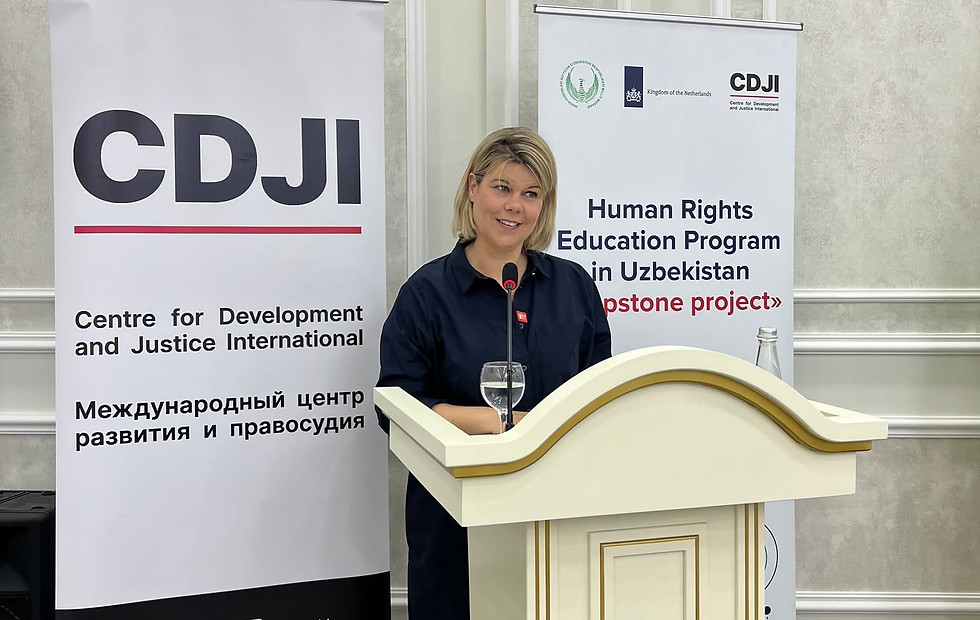
Professor de Vocht emphasised:
“The real challenge is not whether courts can use technology, but whether they can do so without losing the human qualities that make criminal justice fair and legitimate.”
Drawing on her research and the case law of the European Court of Human Rights, Professor de Vocht reflected on how digital justice tools may improve efficiency and accessibility while also raising important questions concerning communication, participation, procedural fairness, and public confidence in judicial institutions. She stressed the importance of ensuring that technological innovation remains compatible with the fundamental safeguards that underpin the right to a fair trial.
The lecture was followed by an interactive discussion and question-and-answer session, during which participants explored contemporary challenges at the intersection of human rights, criminal procedure, artificial intelligence, digital governance, and access to justice. Participants exchanged views on the opportunities and risks associated with the increasing use of technology in justice systems and discussed how legal frameworks can adapt to ensure that innovation remains aligned with international human rights standards.
As part of the programme, Professor Dorris de Vocht also held individual consultations with student teams participating in the Capstone Project Uzbekistan. During these sessions, participants presented progress on their ongoing human rights research projects and received expert methodological guidance, feedback, and recommendations aimed at strengthening their analytical frameworks, research design, and comparative legal analysis.
Professor Dorris de Vocht is an Associate Professor of Criminal Law and Criminal Procedure at Tilburg University in the Netherlands. Her research focuses on criminal procedure, human rights, digitalisation of justice, and the impact of technological innovation on fair trial guarantees. She has published extensively on criminal justice reform, procedural safeguards, digital justice, and the evolving relationship between technology and human rights within judicial systems. Her work combines doctrinal legal analysis, empirical research, and comparative perspectives to examine how technological transformation is reshaping criminal proceedings and the protection of fundamental rights.
The event forms part of the Human Rights Education Programme in Uzbekistan – Capstone Project, a joint initiative implemented by the National Centre for Human Rights of the Republic of Uzbekistan and the Centre for Development and Justice International (CDJI), with the support of the Embassy of the Kingdom of the Netherlands in Uzbekistan. The programme seeks to develop a new generation of researchers capable of conducting high-quality, evidence-based human rights research and contributing to legal and policy reforms grounded in international standards and comparative practice.
Through public lectures, expert mentoring, academic exchanges, research supervision, and practical engagement with leading international scholars, the programme contributes to strengthening human rights education, fostering critical thinking, promoting academic excellence, and encouraging informed dialogue on contemporary legal and societal challenges facing Uzbekistan and the wider region.
Find us:
Madrid, Spain
Terms & Conditions
Privacy Policy
Refund Policy
© 2025 by CDJI