
"I firmly commend Tajikistan's willingness to strengthen the oversight of places of detention and urge ratification of the OPCAT as soon as possible. This is an opportunity to tell the story of the changes and reforms made in Tajikistan, particularly its prison system, and to set the path for the future, enabling continuous improvement. By ratifying OPCAT, Tajikistan would join a global community committed to preventing torture and ill- treatment."
H.E. Katherine Smitton, British Ambassador to the
Republic of Tajikistan
NEWS
International Conference on the Ratification of OPCAT and the Establishment of the NPM in Tajikistan Held in Dushanbe
International Conference on the Ratification of OPCAT and the Establishment of the NPM in Tajikistan Held in Dushanbe
3 February 2026, Dushanbe, Tajikistan
On 3 February, a high-level international conference was held in Dushanbe, dedicated to the Optional Protocol to the UN Convention against Torture (OPCAT), the exploration of pathways to its ratification, and the establishment of a National Preventive Mechanism (NPM) in the Republic of Tajikistan.
The event was attended by representatives of the Human Rights Guarantees Department of the Executive Office of the President of the Republic of Tajikistan, the Office of the Human Rights Commissioner (Ombudsman) of the Republic of Tajikistan and other state bodies of the country, as well as Ambassadors of the European Union, the United Kingdom and other countries accredited in Tajikistan, members of the UN Subcommittee on Prevention of Torture, , and representatives of international and national civil society organisations.
The conference was organised by the public organisation “Bureau of Human Rights and Rule of Law” jointly with the Office of the Human Rights Commissioner of the Republic of Tajikistan and a partner organisation Centre for Development and Justice International within the framework of the implementation of the following projects:

- “Advancing Fundamental Rights: Strengthening Civil Society, Preventing Torture and Transforming Prisons for Human Rights in Tajikistan”, funded by the European Union and implemented by the Bureau of Human Rights in partnership with the public organisation “Tashabbusi Huquqi” and the French organisation Prison Insider.
- “Supporting National Human Rights Institutions and NPMs in Preventing Torture and Monitoring Places of Detention in Tajikistan and Uzbekistan”, funded by the UK FCDO in partnership with the Centre for Development and Justice International (CDJI).

Within the framework of these initiatives, a pilot group for monitoring places of deprivation and restriction of liberty was established in Tajikistan, comprising staff of the Office of the Human Rights Commissioner and representatives of civil society. Members of the group have received practical training, applied standardised monitoring tools and carried out joint visits to places of deprivation and restriction of liberty. As a result of this work, a comprehensive monitoring report with findings and recommendations is being prepared.

In his opening address, the Ambassador of the European Union to Tajikistan, Radosław Darski, stated:
“Today’s conference is not an end in itself. It is an opportunity to deepen understanding, address concerns, and chart a realistic and nationally owned path forward.The European Union encourages Tajikistan to continue exploring OPCAT ratification with openness and ambition, and to engage all relevant stakeholders in shaping a strong pre-emptive framework”


Elīna Šteinerte, Chair of the Board of the CDJI, Member UN Subcommittee on Prevention of Torture (SPT)

"OPCAT is a torture prevention instrument requiring the establishment of very own national preventive mechanism (NPM) in each State party. The NPM is not an investigative body, but rather a forward-looking, preventive entity to assist the authorities with the future-proofing of systems against any risks of torture and ill-treatment. This national ownership is key to effective solutions and OPCAT therefore is indispensable for the Tajik society."

“The mandate deriving from OPCAT gives NPMs a unique role in observing systemic weaknesses, not focusing solely on individual cases in places of deprivation of liberty, and considering how to improve matters through dialogue with the authorities and to ensure greater protection. With OPCAT ratification will have international guarantee of full and unhindered access to all locations where persons deprived of liberty, as well as an international partner in the fight against torture.”
Anica Tomšić, International expert, Member UN Subcommittee on Prevention of Torture (SPT)

Umed Bobozoda, Human Rights Commissioner (Ombudsman) of the Republic of Tajikistan
“An analysis of the activities of the Monitoring Group under the Ombudsman revealed that it could serve as a foundation for establishing a NPM in accordance with the OPCAT, which provides for a mechanism of continuous monitoring of places of deprivation or restriction of liberty in order to prevent torture. The Working Group for the Promotion and Ratification of the OPCAT, operating under the Ombudsman, has held numerous meetings since the inception of its activities and continues to examine the conditions for the further ratification of the instrument.”
The event was held with financial support from the European Union and the British Embassy in Tajikistan through the FCDO, with co-funding from the Office of the UN High Commissioner for Human Rights and the OSCE Office for Democratic Institutions and Human Rights (ODIHR).
Delivering the opening remarks, a representative of the Human Rights Guarantees Department of the Executive Office of the President of the Republic of Tajikistan, Hokimbek Sodikzoda, noted:
“For the effective implementation of the OPCAT, deep and systemic reforms must be carried out prior to its ratification. Various documents have repeatedly emphasized the decision of the Government of the Republic of Tajikistan to ratify the Optional Protocol. Continuous and joint efforts by the government, international organisations, and civil society have never ceased, and significant progress is being made toward the ratification of the OPCAT.”

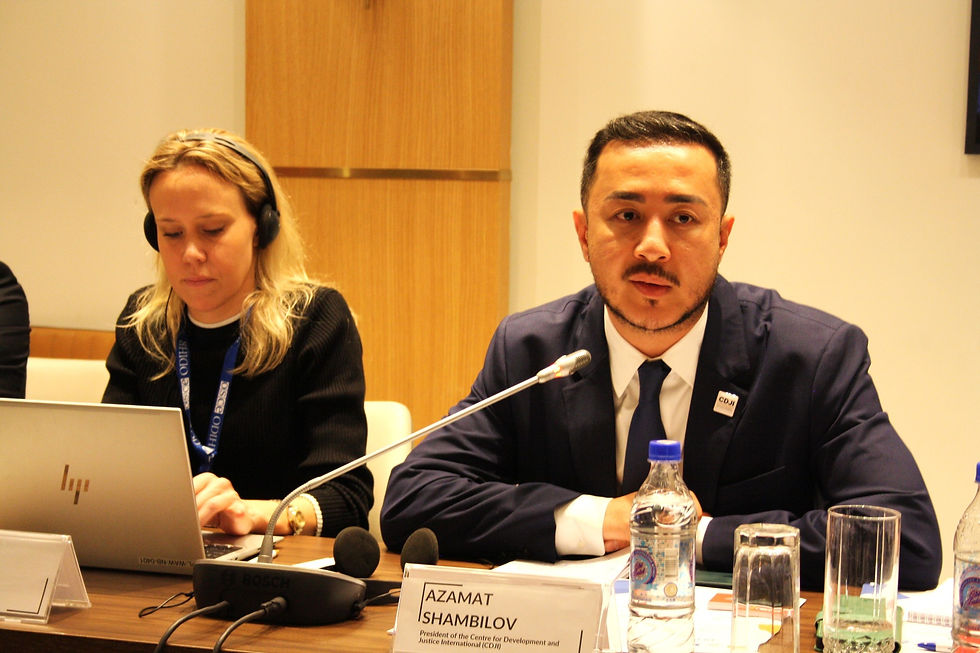
"OPCAT is a vital international instrument that enables the establishment of an independent and sustainable preventive oversight mechanism. By strengthening transparency and accountability in all places of deprivation of liberty, it not only helps prevent torture and other forms of inhuman or degrading treatment, but also advances the country's institutional development and reinforces the credibility of its closed facilities in the eyes of the international community."
Azamat Shambilov, President of the Centre for Development and Justice International (CDJI)
Find us:
Madrid, Spain
Terms & Conditions
Privacy Policy
Refund Policy
© 2025 by CDJI